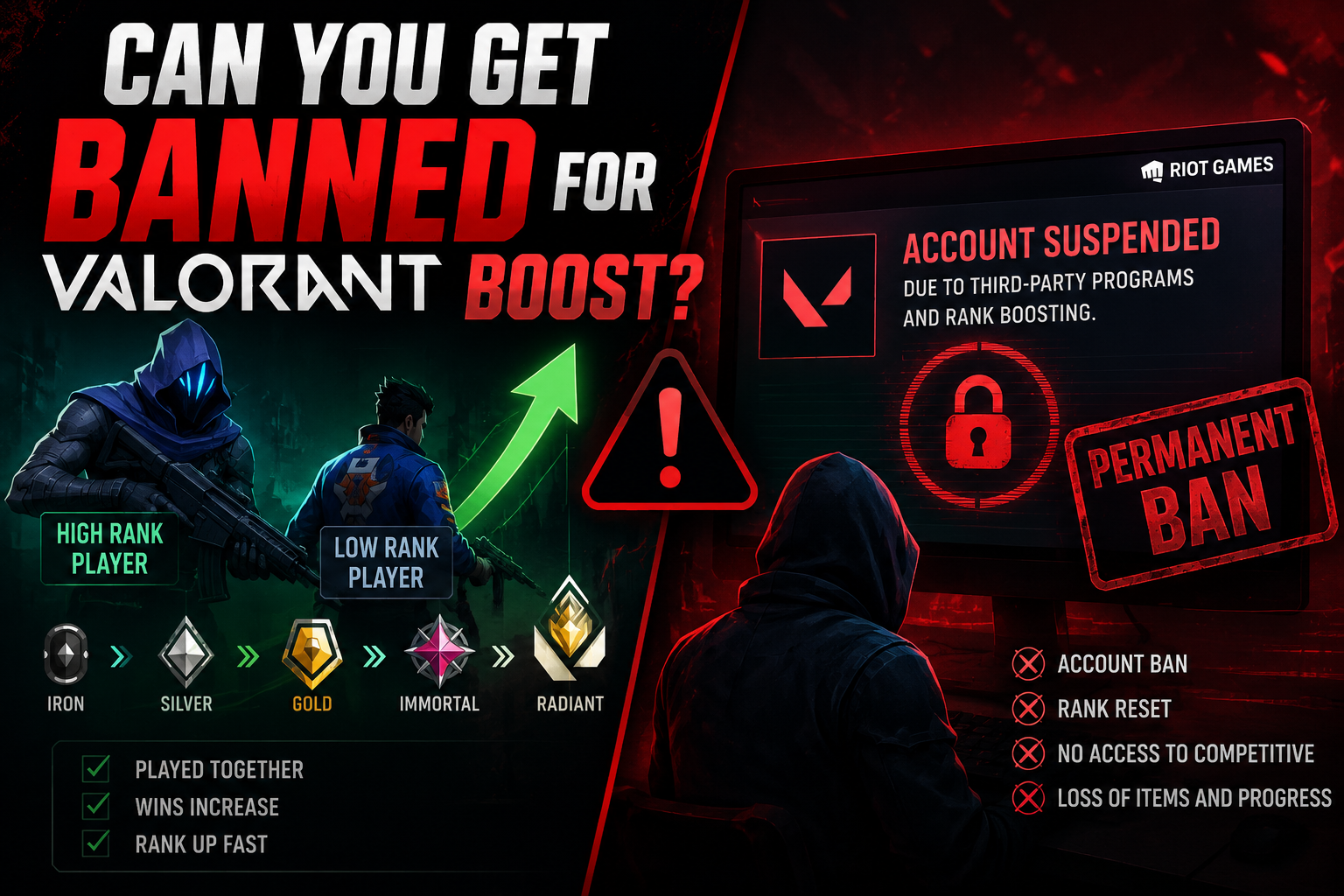
If you’re searching can you get banned for valorant boost, you’re really asking two things: how Riot treats boosting in practice, and what usually gets accounts flagged.
In plain language, Valorant elo boost refers to a scenario where a high-ranking player facilitates you to rank up faster than you would if you were to do that solo, either by playing alongside you or using your account. For instance, when talking about Valorant boosting from Eloboss, it refers to the situation where a Radiant-ranked boosters assists in your ranking process through duo queue, training, and account share boosting, among other things.
The purpose of this guide is to remain neutral and factual by highlighting aspects such as considerations prior to ordering, detection, consequences, and minimizing risks.
Things to Consider Before Ordering a Boost
Start by deciding which method you’re actually comfortable with, because the risk profile changes a lot depending on how the boost is delivered.
Account-share (sometimes called piloted boosting) means someone else logs into your Riot account and plays ranked for you. It’s usually the most convenient, but it also creates the cleanest “paper trail” in account security terms: new device, new IP patterns, and activity that doesn’t match your normal routine.
Duo queue boosting (also called self-play carry) means you stay on your own account and queue with a higher-skill player on their account. You keep control of your login, which removes a major security variable.
“Duo queue boosting remains popular because players can participate in every match while working toward their rank goal,” says Eloboss, a Valorant boosting and coaching service.
Before paying for anything, it helps to pressure-test the provider like you would any online service that touches your account or money:
- What is the process exactly, duo queue, coaching or account-share?
- In which regions and on which servers is the account supported?
- How does the support work if you feel something wrong during the order?
- What is the refund policy, and in particular what about unfinished orders?
- Does the provider make absolute guarantees, such as zero risk? (Absolute guarantees are usually a good indicator that the page is selling, not informing you).
Common features that players often look for include progress tracking, privacy options, region support, account-protection measures, and multiple service formats such as duo queue, coaching, or account-share boosting.
Standard Techniques of Boosting Detection
Although Riot has not provided an official list of criteria for “boosting detection,” there are some standard techniques used in most competitive video games.
Login and location inconsistencies
A sudden shift in where the account is accessed from can stand out, especially if it looks like a rapid jump between regions or repeated logins from known VPN endpoints.
Even if you travel, most people don’t teleport across continents in the span of a few hours, then immediately start grinding ranked with a very different performance profile.
Artificially high performance peaks
Sudden jumps may catch the eye, for example:
- Win streaks way beyond what you have shown before historically
- An abrupt rise in KDA ratio, headshot percentage, or impact metrics over multiple games
- A fast climb in ranks within a short span
While none of them is by themselves conclusive evidence of boosting, they are all factors in building a case.
Discrepancies between behavior and play style
Users exhibit certain behaviors through accounts – their preferred agents, buy styles, speed, and timing of decision making. If these features suddenly undergo an overnight change, it would appear that someone else was using the account.
Practical example: After spending months controlling maps using keyboard, you realize that your account fights in duels aggressively and gets into the map in seconds.
Reports, chat, and avoidable receipts
Allegations made by players do not point at any guilt, yet their aggregation brings up concerns. In addition, even the chats might be proven useful for providing evidence if players talk freely about paid boosting and use of their accounts.
If keeping things discreet is important to you, keep everything you say in chat such that you wouldn’t mind it being screen-captured and sent around.
Potential Penalties for Boosting Violations
However, punishments differ depending on what Riot considers to be the case and what they can prove. Consider this to be more like a spectrum of possibilities.
Some of the most frequent punishments people discuss include:
- Temporarily suspending an account
- Limiting access to ranked matches/queues for that period
- Extending suspensions due to account sharing issues
- Permanent bans in extreme cases where the violations involve another infraction (such as cheating on the shared account)
There’s one fact most tutorials forget to mention: If the account you’ve boosted isn’t being permanently banned, the disruption of having your account suspended for a week at a crucial time during the season, being ineligible for ranked play, or having a locked account might be a worse “price” than getting the boost.
How Riot Handles Boosting and Account Sharing
According to Riot Games’ general policies, boosting and the sharing of accounts in their competition titles is prohibited. However, as far as how this policy is enforced, it is a combination of both automatic triggers and manual reviews.
It’s also worth separating two ideas that often get mixed together:
- Account security: whether someone else accessing your account looks like unauthorized access
- Competitive enforcement: whether the ranked results look like manipulation of matchmaking integrity
Duo queue boosting tends to avoid the first category because you aren’t handing over credentials. Account-share boosting tends to collide with it by default, even if the booster uses precautions.
Based on internal order patterns from Eloboss, placement matches and rank progression services tend to be the most requested options, especially at the start of a new ranked season.
Risk-Reduction Tips for Valorant Boost Users
None of this removes the risk, but here are the measures that help reduce exposure the most.
Choose approaches that allow you to play from your own account
If your goal is to minimize account-security risk, duo queue or coaching is the cleaner route because your login stays with you.
Coaching is also the most “future-proof” option in the sense that your improvement carries over after the sessions, and there’s no second player touching your account.
Keep your account activity consistent
Accounts that appear “normal” receive less scrutiny than those that make drastic changes overnight. If you want to avoid being too suspicious:
- Avoid cramming an enormous change in ranking in a very small period of time
- Maintain your agent pool relatively similarly to how you typically play
- Avoid dramatic changes in your schedule such as only playing during the day to only ranked games at night
Be careful with offline status tools and third-party apps
Some mention being “offline”. If the technique involves other software that may be employed, think carefully before proceeding. In the case where the purpose is privacy, introducing other software opens up another layer of vulnerability.
Reduce social friction and report incentives
Most “detection” occurs from the intuition of the players who sense something wrong and report it. You can minimize the chance of triggering this chain reaction by maintaining a calm demeanor and keeping your communication quiet.
Another issue when there’s someone playing using your account is making sure they don’t even chat. Not because chatting is necessarily bad, but because it leaves behind a paper trail.
Secure your account like it matters
This isn’t about Riot; this is about you not losing your account.
- Always use a strong password that isn’t easy to guess.
- Use two-factor authentication if possible for both your email and Riot accounts.
- When sharing your account with others, immediately change your passwords after.
Conclusion
Of course, there is the possibility of getting banned due to valorant boost since this kind of behavior might go against the regulations of the company, but the actual possibility depends a lot on the specific technique used. For instance, account-share boosting is likely to give off more security warnings than duo queuing and coaching.
When it comes to using any kind of boost-related assistance, think of it as a compromise decision where you have to choose one of two things wisely.
Join The Discussion: