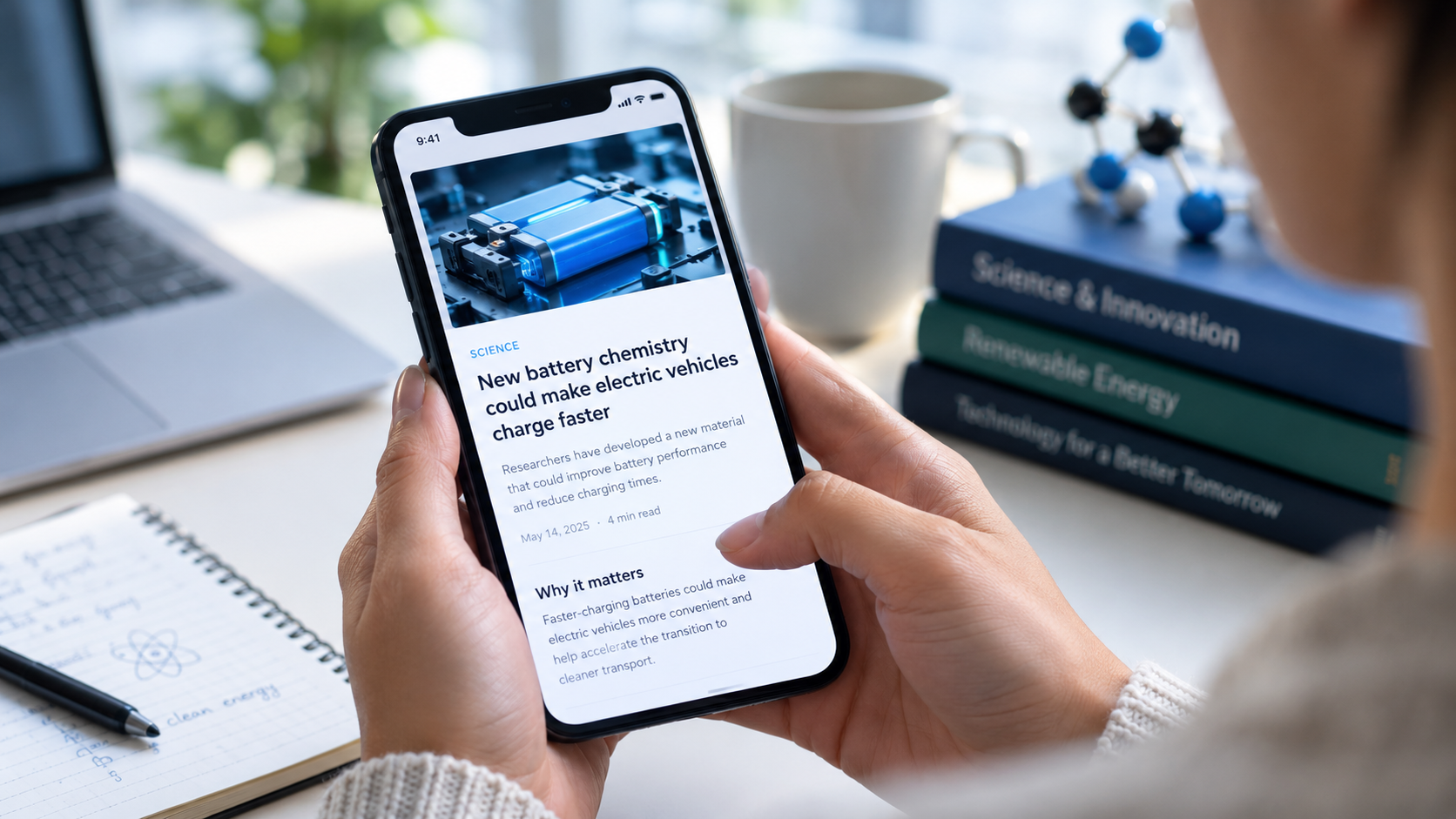
Science news often appears on the same device people use to check messages, watches videos, and troubleshoot technical problems. That’s why mobile presentation is part of the story and not just a publishing feature. A clear article about a new battery chemistry or telecommunications satellite may lose its audience because of excessive jargon, a buried lead, or text that’s difficult to read on a small screen.
This is why writers and editors need to present scientific information accurately without making it sound like a textbook explanation. A few well-chosen techniques (starting with an interesting fact, defining the key ideas in the process, and checking the page on a mobile device) can let the articles appeal to both readers wanting to learn something new.
Begin with the question readers want to answer
A successful science article deserves readers’ interest by providing them with an easy reason for them to care. Instead of beginning the article with a lengthy description of a research methodology, such article should explain what the question of the researchers is and why this question is important. The details should still be present in the article; it is only that they should be simple enough for the audience to understand.
Explain the practical connection without exaggeration
It often happens that the readers encounter science through technology: phones, cameras, health devices, GPS, etc. Linking a research-related result to these devices makes it simpler to understand. One should be careful not to pretend that the research outcome is good enough to be used in the devices.
Translate the complicated terms as early as possible
One needs to define the term as they encounter it. For instance, they explain what a semiconducting material is in the very moment of its introduction into the article.
Make Your Article Easy to Read on a Smartphone
Reading on a small screen requires clear organization.
Short paragraphs, clear headings, and a logical structure make an article easier to understand. This format is especially helpful when an article covers a complex scientific topic that involves explaining key concepts, research findings, limitations, and practical applications.
Headings should have informative content.
They should reflect the main topic rather than being very general. For example, “What the new sensor measures” provides more information than “The technology.” The sections of the text must be organized in the way that an article answers the questions: what it is, how it works, what evidence supports it, and what remains unknown. A person who has only a minute in spare time should be able to get the gist from the headings together with the first sentences since all information will be clear and easy to understand.
Use visual aids in a proper way.
A picture may show how it is built into a phone whereas the comparison picture may help one understand the difference between two types of display or cameras. Add a short caption explaining what the image is about. In particular, avoid using tiny text on the image; it may not be readable on a mobile device and screen readers may have problems interpreting it.
Make sure everything is accurate before publishing.
Good writing does not mean the research is of good quality. Unfortunately, science stories may confuse correlation with causation making it look like a result obtained from a small sample is applicable to everyone. If possible, read the original article, check the sample size and research methodology and look for the limitations. If something is preliminary, make sure to highlight it in the text.
Moreover, it is better to distinguish research findings from conclusions of the scientists. A research paper may contain the results obtained from the experiment but it cannot say how the results obtained may be used in real life.
In case the article is similar to another, get information from an independent source thus avoiding using press releases only.
Finding an Appropriate Venue for a Scientific Article.
Where something is published influences how the article is presented and who reads it. A technical journal, a science website, and a tech platform all target different types of audiences and have different expectations. Before making a pitch, read several articles published recently, and identify the typical article length and level of detail expected by each publication. Directories of science guest-posting sites can be helpful, but it’s important to evaluate each publication individually to determine whether it’s a good fit.
Independent writers should also take into account the practical aspects of finding clients and offering services. Osdire’s article on freelance marketing deliverables provides a broad overview of the freelance digital marketing landscape.
It has a lot of value for scientific authors because one of the most important lessons that can be drawn from it is that every project should be clearly defined. The scope should clearly specify whether the project involves only writing or additional tasks such as research and revisions.
Ensure Quality and Readability in the Process
It has to be mentioned that a successful process doesn’t have to be complicated. Begin by forming your explanation around one key question, check each technical statement made in the text against a reliable source, and review it on a smartphone screen. Remove unnecessary context that does not contribute to answering the question asked but leave disclaimers that reflect the information truthfully. Ask someone outside the field to identify passages that are difficult to understand.
Successful science writing treats readers as curious people instead of ignorant ones. Explain an idea, show its importance, and present gaps in knowledge claimed by researchers. The combination of a clear structure and statements presented above helps create articles that are easy to follow and trustworthy, even on mobile screens.
Frequently Asked Questions
How long should a mobile-friendly science article be?
There is no single ideal length. Use enough space to explain the evidence and its limits, then remove repetition. Clear headings and concise paragraphs matter more than hitting a particular word count.
Should science writers avoid technical terms?
No. Keep terms readers need to understand the subject, but define them when they first appear and use them consistently. Avoid unexplained jargon that does not add useful precision.
How can I tell whether a science claim is overstated?
Compare the claim with the original study’s methods, findings, and limitations. Be especially cautious when a small or early-stage study is described as proof of a broad effect or an imminent consumer technology.
What makes a science publication a good fit?
Look at its recent coverage, intended audience, editorial standards, and whether it publishes the kind of science you are proposing. A relevant subject and a clear match to the publication’s style are better signs than a large list of possible outlets.
Join The Discussion: